Early Spring Trip to Myrtle Beach a Joy
By Tom Lang
A long weekend in early March in Myrtle Beach was just right for a pre-birthday celebration. The only thing missing was being with friends or family, with the one exception of my cousin joining me on that Sunday, Yet, like all golfers know, even golfing with strangers can be a lot of fun. Strangers on the first tee; new friends by 18.
A week prior to my arrival, Myrtle Beach had an unusual and hearty snowfall, a result of all the whacky weather we’ve experienced nationwide in early 2026. But within days there was no trace of the white powder we are used to in Michigan and temps were back in the mid-50s with sunshine.
Direct flights from DTW to Myrtle Beach via Delta is the way to go. Once landing in SC, more than three dozen golf courses are located within 30 minutes’ drive.
Grand Dunes Resort Course:
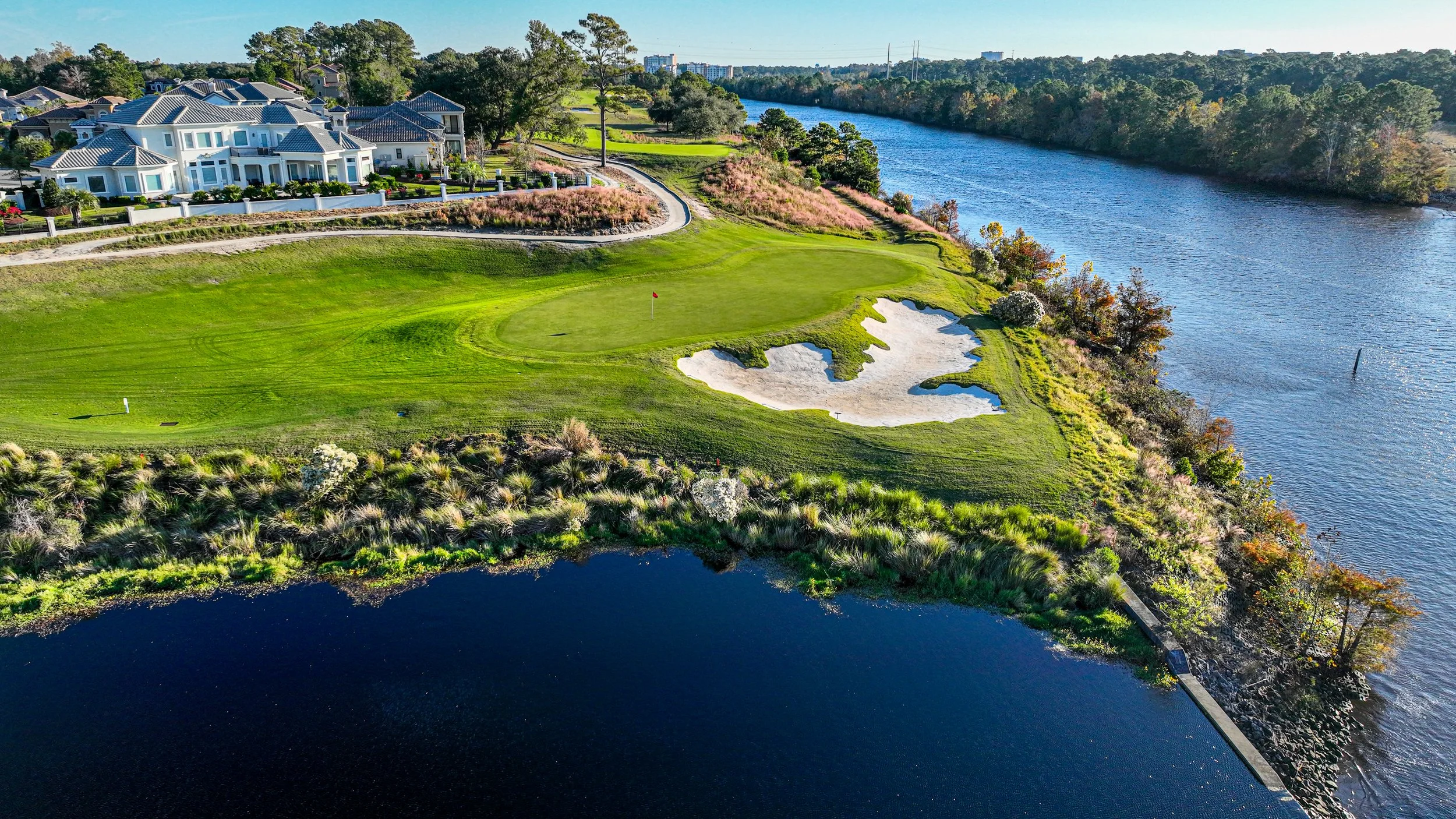
If you like practice facilities before you start your day this is a great location for that. The course has wonderful variations to the land, with rolling hills and a really challenging par 3 on the back with an elevated tee over water and perched high above the intercoastal waterway. Bunkers are nicely placed to provide strategy off the tees, and while most of the greens are surrounded by bunkers, they’re not heavily impeding play – they’re more there for aesthetics throughout the course.
Speaking of birthdays, my two partners that day were celebrating their own – Don Krager of Myrtle Beach/Springfield IL and local resident Patrick Tyree.
“Of all the courses down here, I think of Grand Dunes as challenging, but it’s fair,” Krager said. “It’s an open course where you can spray the ball a little bit, but it’s still well bunkered and has water, and difficult greens to maintain the challenge. It’s also one of the more well-conditioned courses in Myrtle Beach as well. So, as a special treat for my birthday I decided to come out here and treat myself to a round at Grand Dunes.”
Pine Lakes Country Club:
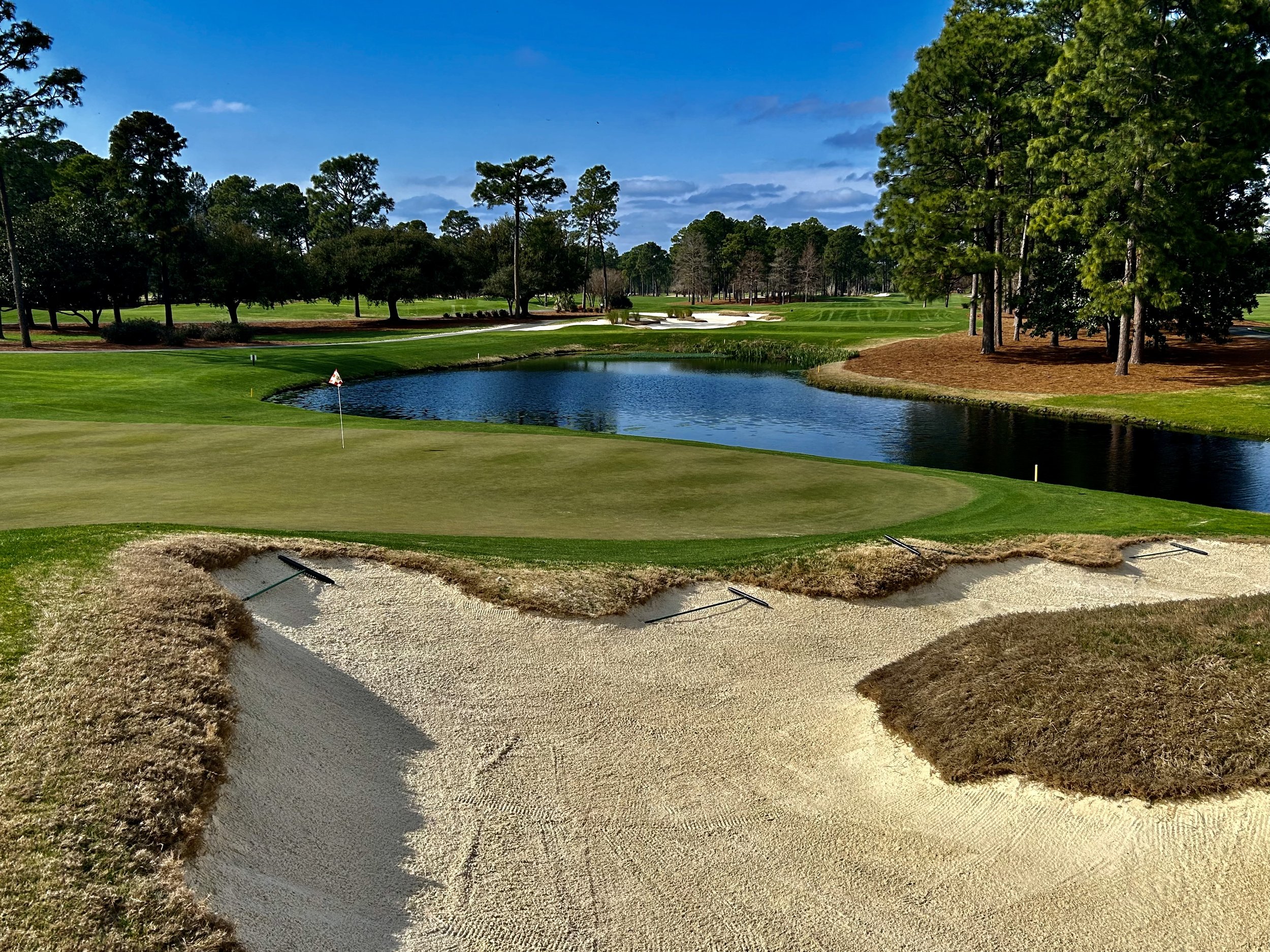
Founded in 1927, it was the first course ever in Myrtle Beach. Now semi-private and open to the public, the layout played very traditionally with not much undulation in the greens. Tall, majestic Southern Pines lined the majority of the fairways, dropping their very large, soft needles so you get lots of conventional down-south Pine straw underneath.
Hole number 3 looks relatively innocent, but earns its No. 1 handicap. Not only is it long for a par 4 but there is a large pond guarding the front right side of the green complex. What makes it devilish is that virtually the entire grass approach area slopes and funnels right into the pond so it makes the hazard play like, and feel like, it’s twice the water surface size. A ball retrieving entrepreneur who was fishing out golf balls (mine too) as I played through said that he stays plenty busy coming out to the 3rd hole and the adjacent No. 6.
Pawley’s Plantation:
The longest car drive south (45 minutes) on the Myrtle Beach rotation is found in Pawley’s Island, SC. It introduces the most unique feature I’ve seen on a golf course in decades.
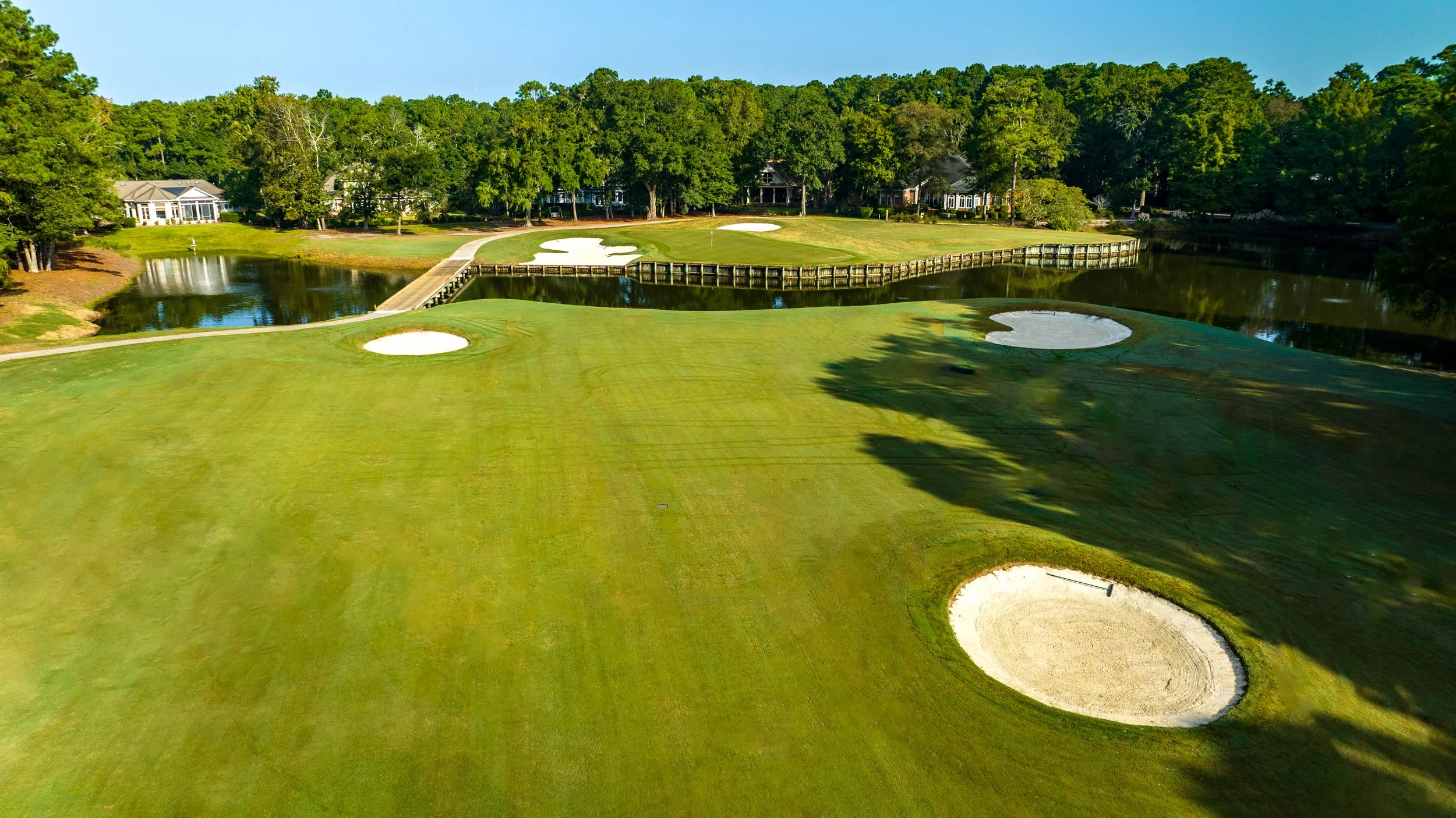
The apx. 250-yard cart ride from the 12th green to the 13th tee is a man-made ‘natural bridge’ about 10 feet wide traversing through low country, with cart parking cut outs and grass tees along the way to the 13th hole – a short but tough par three, where golfers hit to a peninsula green surrounded on three sides by hazard. Golfers then play three more holes before returning to the same ‘bridge’ to go back to the tee box for the 17th tee to play another par 3.
“I think it’s a fantastic layout, with very creative use of the land,” said Matt Betts (cousin from Kalamazoo). “It was a little tricked out, but in a good way… That entire 13 and 17 combination is incredible. So beautiful, and even though it seemed weird at first, it made perfect sense after you understood what was going on. But routing everyone through that little slip made it much more of an experience for everyone. It gives you multiple water-based views and some difficult, creative holes. Overall, I thought it was incredible; and I’d come back.”
TPC Myrtle Beach:
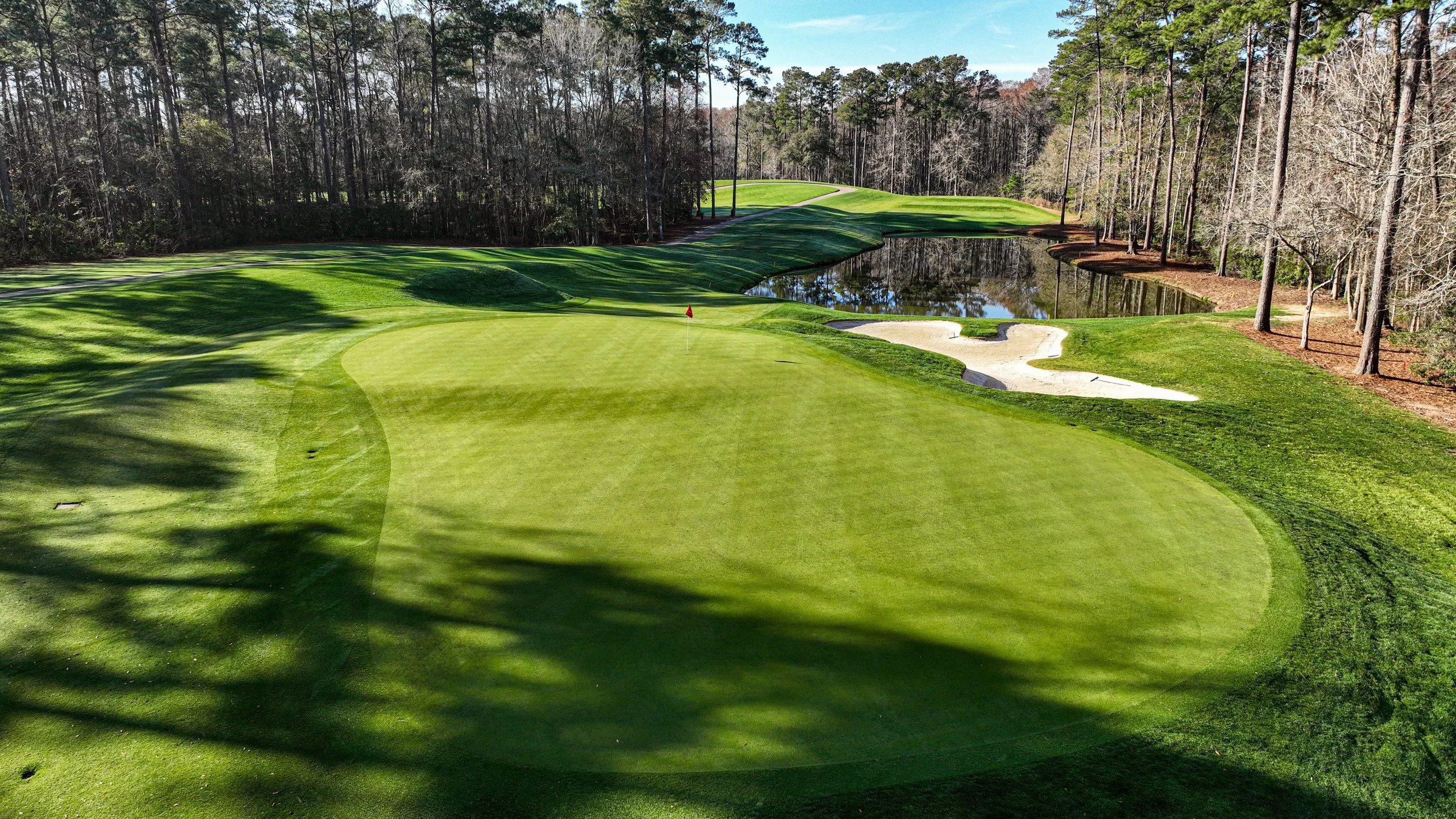
It would be unfair to say this golf course looks Augusta National-esque, but because the geographic regions are not that far off, the area does have a lot of the same vegetation. Like Augusta National, there’s an abundance of tall, slender Southern Pines lining many fairways.
I played with two college boys on spring break who said this is always their favorite course to play because it’s always an immaculate condition, something anyone would expect when part of the TPC network. Aggressive, rolling hills make it fun, interesting, and very good looking. One aspect that stood out were the bunkers; deeper and more scooped out and purposefully-shaped more so than the other courses I played in Myrtle Beach.
The TPC was in extra good condition because the Dustin Johnson junior amateur event was to take place one week later, so they were not even allowing carts on any of the fairways, all adding to extra nice conditions.
Myrtle Beach National, Kings North:
Arnold Palmer designed Myrtle Beach National has its North, South and West courses. So, it made sense to the ownership group to bring in a Palmer disciple to make some updates and renovations. Enter Branden Johnson, who worked for Palmer more than 17 years and became VP and senior golf course architect. He now hangs his own shingle in Florida.
Johnson told me that Palmer made a huge impact on his life. As a junior golfer he did a research paper on Arnold in 10th grade and never dreamed of working for him as an adult. “Knowing someone of that caliber trusted me with his design legacy is huge. He was friendly, he was open, he was helpful. And you couldn’t ask for a better mentor to collaborate with.
“We did not touch everything (on the North renovation),” Johnson added. “It was a limited scope of work, so the task of disguising where it is we started and stopped was also key. Yes, we worked a lot around the greens and you can see some greens are changed, but probably less change than people think. We touched certain areas that made big impacts.”
My biggest takeaway was all the waste sand areas used for a combination of aesthetics, melded bunkering on the edges – and also for cart paths in place of asphalt – removing ugly paths out of the equation. All the new bunkering was very nicely redesigned from lots of small, scattered bunkers, into larger ones on some holes. One example was hole 18, that went from nearly 40 bunkers down to about a dozen.
I played with fellow media member Michael Williams, who I met 15 years earlier out of Washington, D.C.’s CBS Radio. His ‘19th Hole with Michael Williams’ show has since gone to podcast with a following in the millions.
“I liked it because it’s a course I can do a variety of things,” he said. “If you want to play this course for fun, you can definitely have fun out here. It’s not so much water with so much difficulty (like other courses). But if you want to be competitive you can move back and add yardage. I don’t think you can have a bad time on this course.”