
By Tom Lang
The original Marquette Country Club, located in the hills and valleys of property southwest of the historic mining town, is home to both The Heritage (the original) and Greywalls, the modern-day marvel that draws golfers from across the world.
If you are one of the latter, make sure to play The Heritage as well. This year is the 100th anniversary of this wonderful old classic that’s endlessly well taken care of with modern equipment and grass knowledge to make it an incredible modern-day experience with an old-time feel.
“I’m a big fan of old school golf,” said Marc Gilmore, director of golf at Marquette. “It’s fun here too. You don’t have to be as precise. We’re on 123 acres so you can spray it a little into another fairway and you still have a shot. Whereas a lot of courses today are tree-lined, out-of-bounds lined and you have to be more precise. It’s a lot more fun just to play.
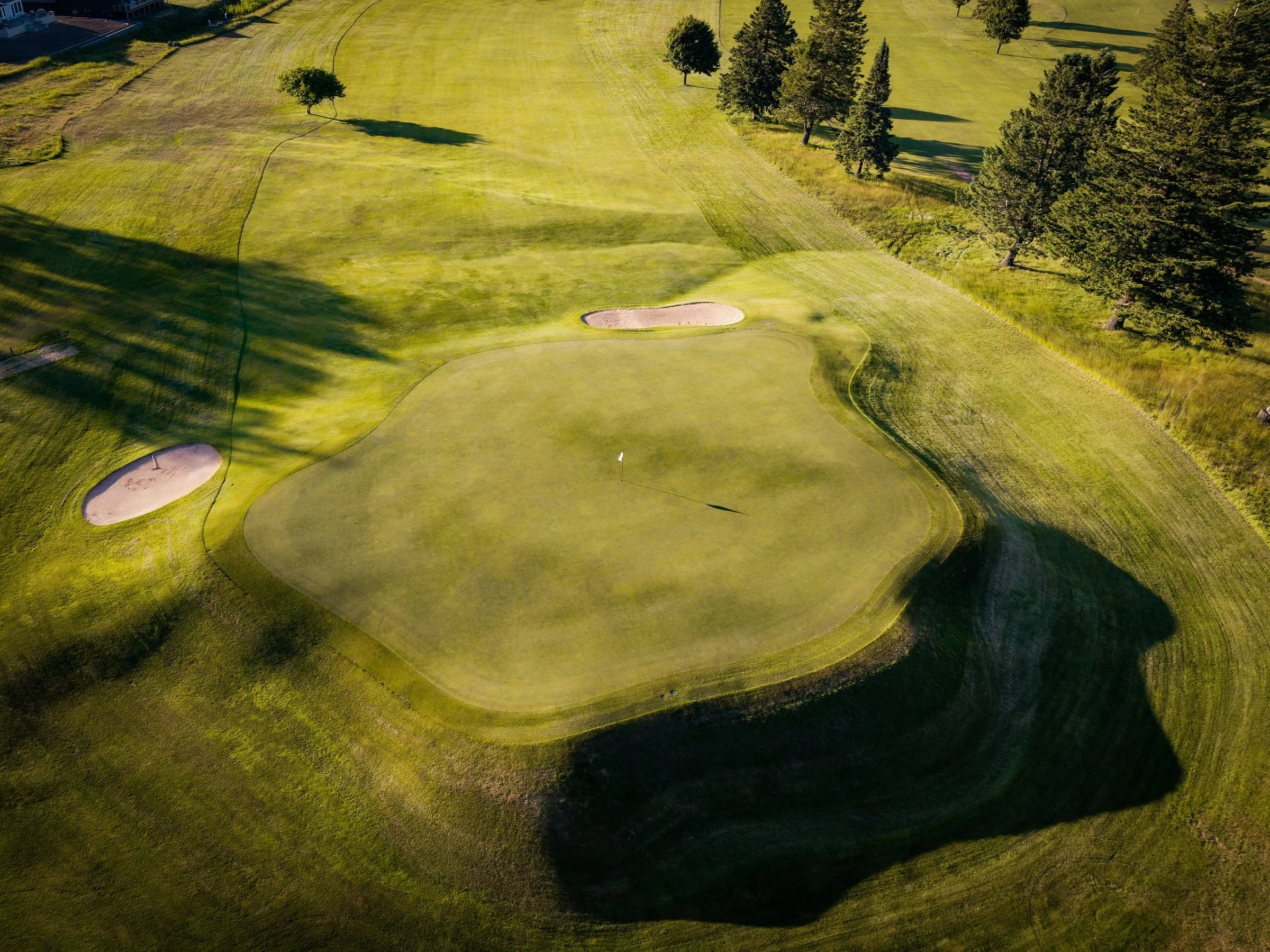
“Back in the 1920s, (designers Langford & Moreau) was famous for large platform greens, pop-up greens. Holes 4, 8, 11, 12. These are all manufactured pop up greens, big terrace greens with sharp drop offs on both sides, and the back. That was kind of his little niche back then. There’s some false fronts, but they’re huge greens that play smaller than they look.”
While crisscrossing Michigan in the 1920s, Langford & Moreau designed the Country Club of Lansing, and Blythefield outside Grand Rapids as well.
At Heritage, my favorite stretch of holes the multiple times I’ve been able to visit, are holes 4-8, all classics.
Hole 4 green is just outstanding. Not only is it huge, but it has a lot of movement and is very tough to read putts so although it’s a shorter par five from the middle tees, par is protected by the difficulty of putting on that green.
Now onto the par three 5th, a very nice medium length slightly uphill hole that’s fair and reachable to everybody. A large trap guards the left side of the green with two smaller traps on the right side.
Then jump next door to hole No. 6, and it is a shorter par four that’s drivable for some people. Adding to the challenge for some players is a ravine that goes through the middle of the fairway and also feeds through the landscape to create a large gorge to go over on the next hole, No. 7, the most attractive par three on the course in my opinion. Number 7 is a little downhill but with a hard slanting back to front and left to right green. Short shots land in the ravine, and going long is a difficult chip back to the green running away from you.
Follow that up with number 8, which is a slightly blind tee shot where you want to get off the tee and over the hill so it can extend your drive down the fairway as it turns a little right to left. The green is a beautifully perched design with some traps on the left front and a depression running across in front of the green that keep balls from just running up if you don’t get it airborne. Again, it’s another large green that has lots of pin placement options and just looks very attractive on the approach. It’s one of my favorite green complexes for its visual beauty.
I did not play the back nine this year due to rain out, but my local playing partners reminded me that several of the holes begin to show the look of what they’ll see at Greywalls on the back of the property as far as land movement and shaping. Much of the back nine is located in an area closest to Greywalls. Heritage No. 15 is an elevated tee where you can see the water of Lake Superior.
When the ‘back nine’ was added in 1964, designer David Gill, intermingled his holes with parts of the beginning and ending areas of the original Langford design. Sometimes management allows golfers to play the Heritage original 9; “but the continuity and flow of play doesn’t work as nicely,” Gilmore said. “We allow it on certain days just to honor the old Heritage course, but something day to day wouldn’t work too well.”
For an example of the crossovers, today’s 13th green was the ninth hole under Langford & Moreau.
Gilmore said there has been ongoing updates for many years to make improvements, and there’s still room to take out more tress to make it more like the 1926 design. The next biggest reclamation is bunkering. The routing and greens are original, but some bunkers were added, and some removed over the years. Management is planning to eventually take The Heritage back to the original plans.
For me, it’s just about perfect the way it is now.
More information can be found at: https://golfgreywalls.com/


